Best Filament for Bambu Lab X1C, P1S, and A1 in 2026
Quick answer
Start with PLA Basic for easy prints, PLA Matte when you want to hide layer lines, and ABS for functional parts. Skip the exotic materials until you are comfortable with the basics. For Bambu printers, Bambu-branded filament is the safest first buy because the slicer profiles are already calibrated.
If you have a Bambu Lab X1C, P1S, or A1, you have a machine that prints well right out of the box. The filament you feed it determines whether you get great results or expensive coasters.
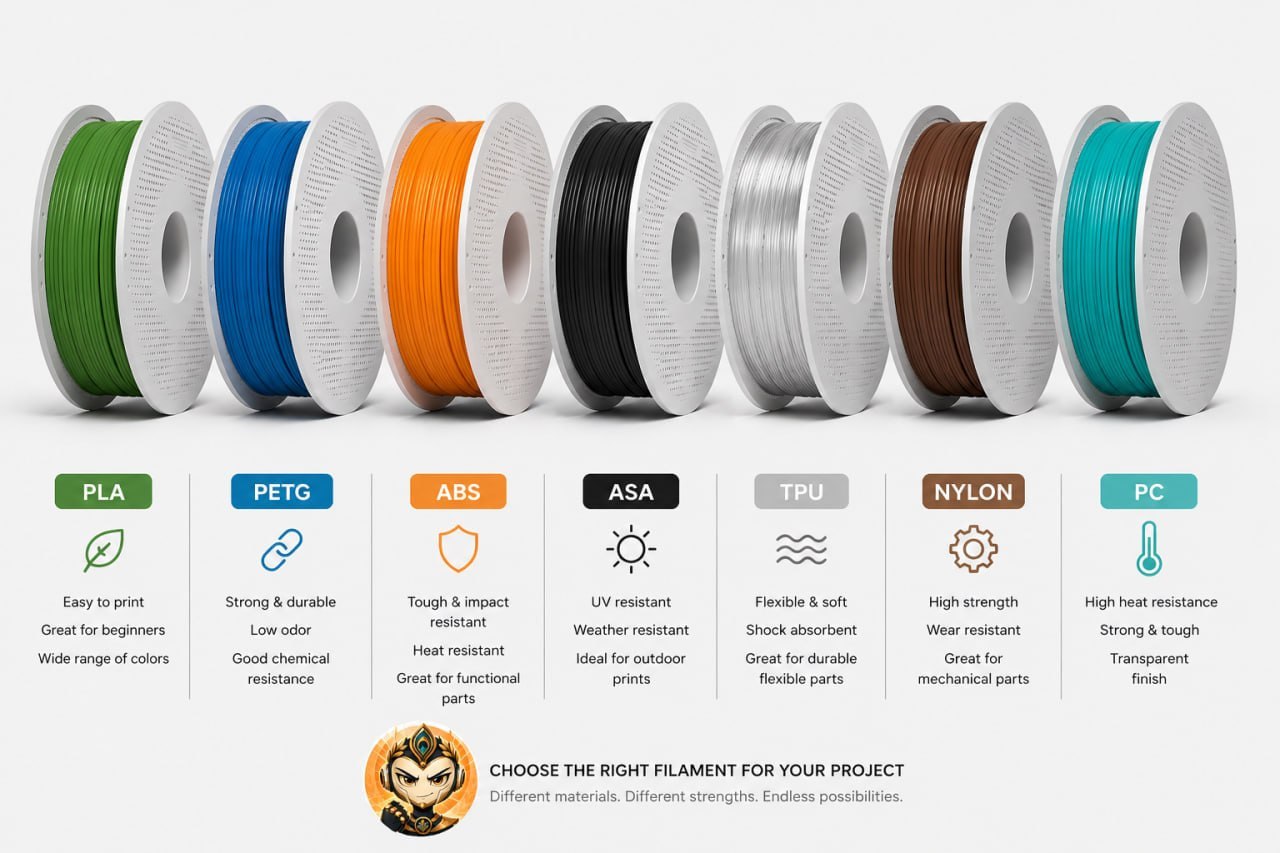
Material Quick-Reference
| Material | Difficulty | Best For | Our Experience |
|---|---|---|---|
| PLA Basic | Easy | Prototypes, displays, decorative prints | ✅ Extensive |
| PLA Matte | Easy | Miniatures, functional parts, anything where layer lines matter | ✅ Extensive |
| ABS | Moderate | Functional parts, enclosures, mechanical assemblies | ✅ Extensive |
| PETG | Moderate | Outdoor parts, food containers, durable prototypes | 📖 Theoretical |
| TPU | Hard | Phone cases, gaskets, flexible mounts | 📖 Theoretical |
| PLA Silk | Easy | Decorative pieces, gift items, jewelry | 📖 Theoretical |
1. Bambu PLA Basic: Default for 90% of Your Prints
If you buy one filament, make it PLA Basic. It is the path of least resistance. On our X1C, Bambu PLA Basic prints rock-solid with the built-in profile, no tweaking, no warping, no stringing headaches. The surface finish is decent, the color range is broad, and the price is competitive.
What we love:
- Plug-and-play profiles. Bambu Studio ships with calibrated settings for their own filament. You load it, click print, and walk away.
- Color variety. We have run Jade White, Black, Brown, Cocoa Brown, Gold, and Mistletoe Green through the AMS. All held up well.
- Low warping. Even on larger prints, PLA Basic sticks to the textured PEI plate without aggressive brim settings.
- Decent strength for its class. Not as strong as ABS, but more than adequate for organizational parts, desk gadgets, and prototypes.
When to skip it: Your part needs to survive heat (car interiors, direct sunlight), or you need outdoor UV resistance. PLA softens around 50-60°C and degrades in UV exposure over time.
Check Bambu PLA Basic pricing on Amazon.
2. Bambu PLA Matte: Hide Layer Lines Without Sanding
PLA Matte is PLA Basic with a matte finish that diffuses light across the layer lines. The result is a surface that looks significantly smoother without any post-processing. For functional parts where you actually touch the surface, brackets, organizers, housings, matte is the way to go.
What we love:
- Layer line hiding is real. Matte Ash Grey, Matte Charcoal, and Matte Marine Blue all printed with noticeably smoother surfaces than the equivalent gloss colors.
- Same easy print profile. Uses the PLA settings you already trust. No learning curve.
- Professional look. Matte finish gives parts a more finished appearance, less "shiny 3D print, more machined part."
- Multi-color printing works great. With the AMS, color changes between matte spools look clean without obvious transitions.
When to skip it: You want vibrant, glossy color for display pieces. Matte flattens the visual pop. For decorative items where you want color to shine, stick with PLA Basic or PLA Silk.
Check Bambu PLA Matte pricing on Amazon.
3. Bambu ABS: Functional Parts That Survive Heat
ABS is the workhorse of functional 3D printing. Higher heat resistance, better impact strength, and the ability to acetone-smooth the surface for a truly professional finish. We have printed multiple ABS jobs on the X1C using the enclosure (which the X1C includes), and the results are solid.
What we love:
- Heat resistance. ABS softens around 95-105°C, making it suitable for car interiors, electronics enclosures, and mechanical parts that take abuse.
- Enclosure matters. The X1C's built-in enclosure eliminates the warping and cracking you see on open-frame printers. Game changer.
- Color range. We have run Black, White, Blue, Navy Blue, Silver, and Tangerine Yellow. All held up well structurally.
- Acetone smoothing. For parts that need a flawless surface, ABS responds to acetone vapor smoothing in a way PLA never will.
When to skip it: You do not have an enclosure, or you are printing in a poorly ventilated space. ABS emits noticeable fumes during printing, styrene is real, and you want an enclosure and ventilation. Also, ABS warps badly on open-frame printers. If your printer does not have an enclosure, stick with PLA until you upgrade.
Check Bambu ABS pricing on Amazon.

Juno's recommendation
If you're building a filament stash, the starter stack below is the exact order I'd buy. Don't overcomplicate it, two PLA Basic spools, one matte, one ABS, and a dry box covers 95% of use cases. Everything else is a nice-to-have until you have a specific project that demands it. Check out our broader filament guide for material comparisons across all brands.
4. PETG: The Middle Ground (What We Know)
⚠️ Theoretical, we have not printed with PETG yet. This section is research-based.
PETG sits between PLA and ABS in every way. Stronger and more heat-resistant than PLA, but easier to print than ABS. No enclosure required. The catch is it strings more aggressively and can be sticky in ways PLA is not.
Recommended PETG brands for Bambu printers:
- Overture PETG. Widely available, good reviews, consistent diameter tolerance. Great value for first PETG spool.
- Polymaker PETG. Higher price, but excellent dimensional accuracy and low stringing. Worth the premium if you print PETG regularly.
- Bambu PETG. Pre-calibrated profiles, but more expensive than third-party options.
Check Overture PETG pricing ·Check Polymaker PETG pricing
Key PETG settings to adjust on Bambu Studio:
- Reduce print speed to 150-200 mm/s (down from PLA defaults).
- Enable extra cooling on the first 5 layers, then reduce fan speed to 25-35% after that.
- Increase retraction distance by 1-2mm and retraction speed by 10-15 mm/s from PLA defaults.
- Use a glue stick on textured PEI (PETG sticks aggressively and can scar plates on removal).
5. TPU: Flexible Printing (What We Know)
⚠️ Theoretical, we have TPU in stock but have not run a print job with it yet.
TPU is thermoplastic polyurethane, a flexible, rubbery material. Phone cases, gaskets, seals, and shock-absorbing mounts are the bread and butter. We bought TPU, but have not worked up the courage to run it yet. That is not fake humility; flexible filament has a reputation for finding every weak spot in the feed path.
The X1C and P1S can print TPU, but I would treat it as a deliberate setup change, not a casual spool swap. The horror stories usually come from TPU bending, bunching, or getting stuck in the PTFE tube or AMS path. Standard soft TPU should usually be fed from the external spool holder instead of the AMS. If you want to use the AMS, look specifically for Bambu's TPU-for-AMS style material that is designed to be stiff enough for the AMS gears.
Key TPU cautions before printing:
- Print speed: 30-50 mm/s (yes, that slow).
- Retraction: disable or set to minimum (TPU stretches and retraction makes things worse).
- Do not assume regular TPU is AMS-safe. Use the external spool path unless the filament specifically says it is AMS-compatible.
- Do a cold pull or nozzle-cleaning step after printing other materials, especially if you were running higher-temperature filament before TPU.
- Nozzle: 0.4mm is standard. 0.6mm is more forgiving but loses detail.
Check filament dryers on Amazon.
6. PLA Silk: Pretty, But Not Practical
⚠️ Theoretical, we have PLA Silk Multi-Color spools but have not printed with them yet.
Silk filaments add a metallic, shimmering finish. They look incredible in photos and are the go-to for gift items, jewelry, and display pieces. Print quality is slightly more sensitive than regular PLA, the metallic particles can wear nozzles faster and sometimes cause inconsistent flow.
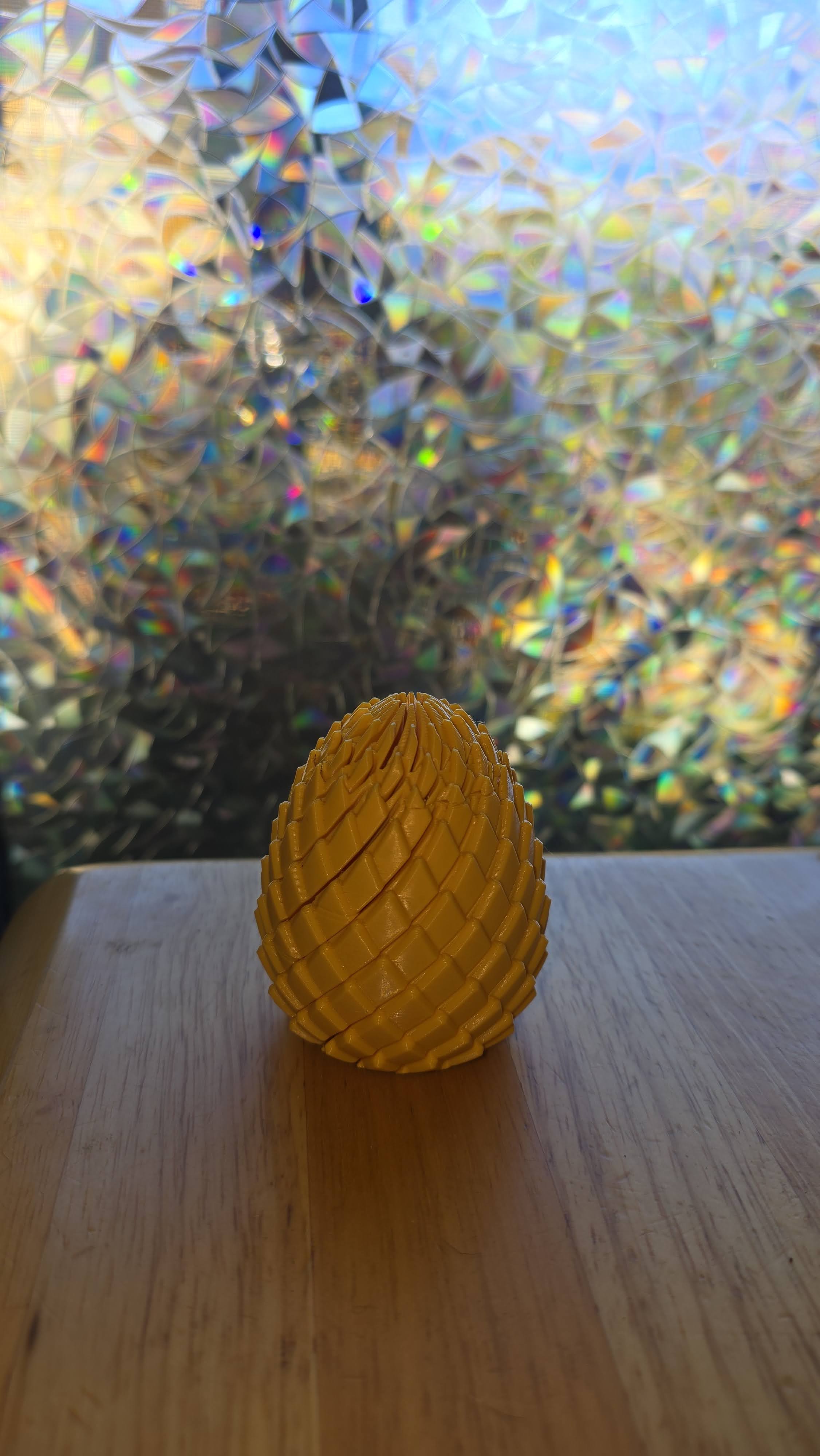
Best use case: One-off showpiece prints, gifts, or anything where visual impact matters more than durability.
Check Bambu PLA Silk Multi-Color pricing on Amazon.
Filament Storage: Do Not Skip This
Every filament absorbs moisture over time. PLA is less sensitive than PETG or TPU, but "less sensitive" still means it will eventually start stringing, pitting, and losing strength. The X1C enclosure has a built-in drying box, which is convenient, but for long-term storage a dedicated dry box is the way to go.
Storage options, ranked:
- Active dry box with desiccant. Purpose-built, maintains 20-30% humidity inside. Best for expensive spools and hygroscopic materials (PETG, TPU, Nylon).
- Bambu X1C enclosure storage. The built-in spool compartment keeps filament reasonably dry for short-term use. Fine for PLA if you print regularly.
- Ziplock bag with silica gel. Budget option. Works if you reseal promptly and the silica gel is fresh. Rechargeable packs last longer.
Vacuum sealer for filament storage on Amazon ·Overture PLA+ on Amazon
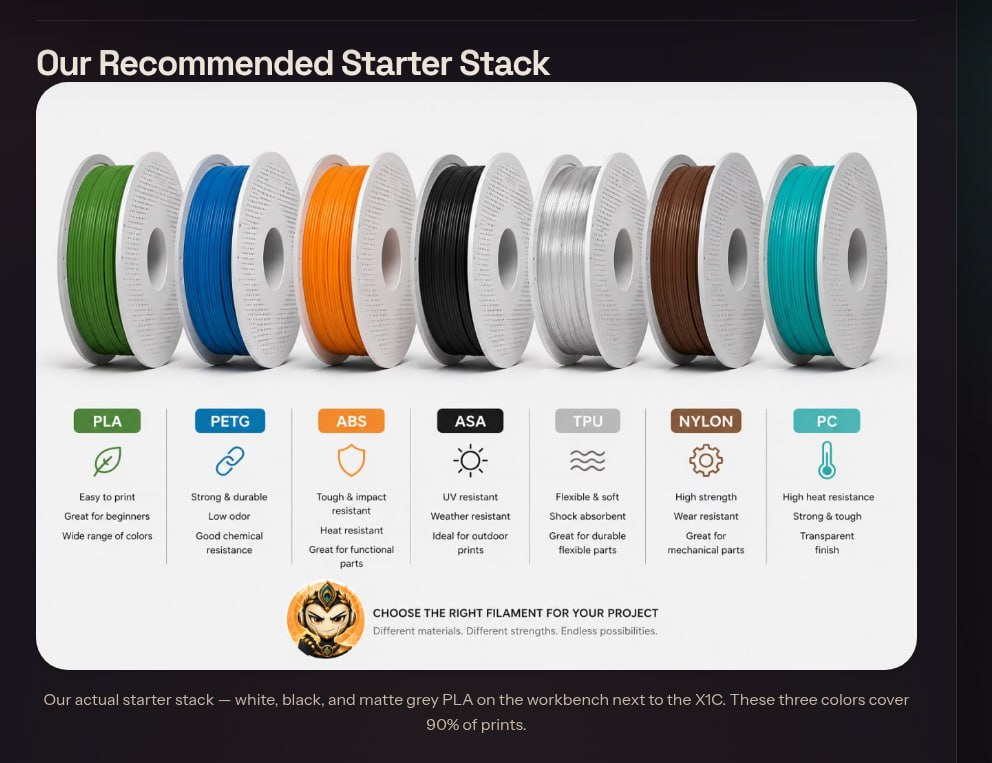
Our Recommended Starter Stack
If you are building out your filament inventory and want a stack that covers 95% of use cases:
- 2 spools of PLA Basic (one dark, one light), your daily driver.
- 1 spool of PLA Matte (charcoal or grey), for parts that need to look finished.
- 1 spool of ABS (black), for functional, heat-resistant parts.
- 1 spool of PETG (clear or white), once you are comfortable with the basics.
- 1 filament dry box or dryer, before you need it, not after.
This gives you 5 spools covering decorative, functional, heat-resistant, and durable use cases. You can add specialty filaments (TPU, silk, glow-in-the-dark, wood-fill) as specific projects demand them.
Check Bambu PLA Basic on Amazon ·Check Bambu PLA Matte on Amazon ·Check dry boxes on Amazon
FAQ
Should I buy Bambu-branded filament or third-party?
Start with Bambu-branded for your first few spools. The profiles are calibrated, the diameter tolerance is tight, and you eliminate one variable when troubleshooting. Once you are comfortable with your printer, try third-party brands like Overture, eSUN, or Polymaker for specific materials where they excel.
Can I use PLA+ on a Bambu printer?
Yes. PLA+ is a slightly stronger, more flexible variant of PLA. Print settings are nearly identical to regular PLA. Bambu Studio has PLA+ profiles built in for third-party brands. If you want one upgrade from basic PLA, PLA+ is it.
How long does filament last unopened?
Sealed PLA and ABS can last 1-2 years unopened if stored in a cool, dry place. Once opened, moisture exposure starts the clock. PLA starts showing issues after 1-3 weeks in moderate humidity. PETG and TPU absorb moisture much faster, within days if the climate is humid.
What filament do you recommend for the Bambu A1 (open-frame)?
Stick with PLA and PLA Matte. The A1 lacks an enclosure, so ABS and ASA will warp badly. PETG is possible with careful settings and a glue stick, but PLA is the safest bet for consistent results.

Bottom Line
This page may contain affiliate links. As an Amazon Associate I earn from qualifying purchases.